Before the reactor. Because the fuel does not mind waiting, and the plant earns its keep regardless. What follows is a recipe. Every number on the card is verified against the published literature; where a figure is assumed rather than measured, it says so.
The only fusion fuel that exists in harvestable, stable form off-world: tritium decays in 12.32 years1, and helium-3 is effectively absent on Mars2. One kilogram, fully fused, releases about 24 gigawatt-hours of heat as a floor — and up to roughly 96 if every secondary product is burned. The floor alone is around 21 kilotons of TNT per kilogram — about one Hiroshima — delivered slowly, and on purpose.3
Where
Buried Mid-Latitude Ice.
Mars water is naturally deuterium-rich. The ground ice we would actually mine runs about five times Earth’s seawater (assumed — not yet measured in place)4; the polar caps, eight times or more (inferred)5; the deep primordial rock, only one to two times6. We choose Arcadia Planitia, near 40° north: shallow ice, up to three-quarters of the ground by volume7, below the landing-altitude ceiling8. Not the richest ice on the planet. The reachable ice.
Where — the icedrop assets/stage0_where.jpgrecommended 1200×1200 or wider
Cross-section of Arcadia ground ice.
How
Do Not Build a Deuterium Plant.
Tap the water plant you were landing anyway.
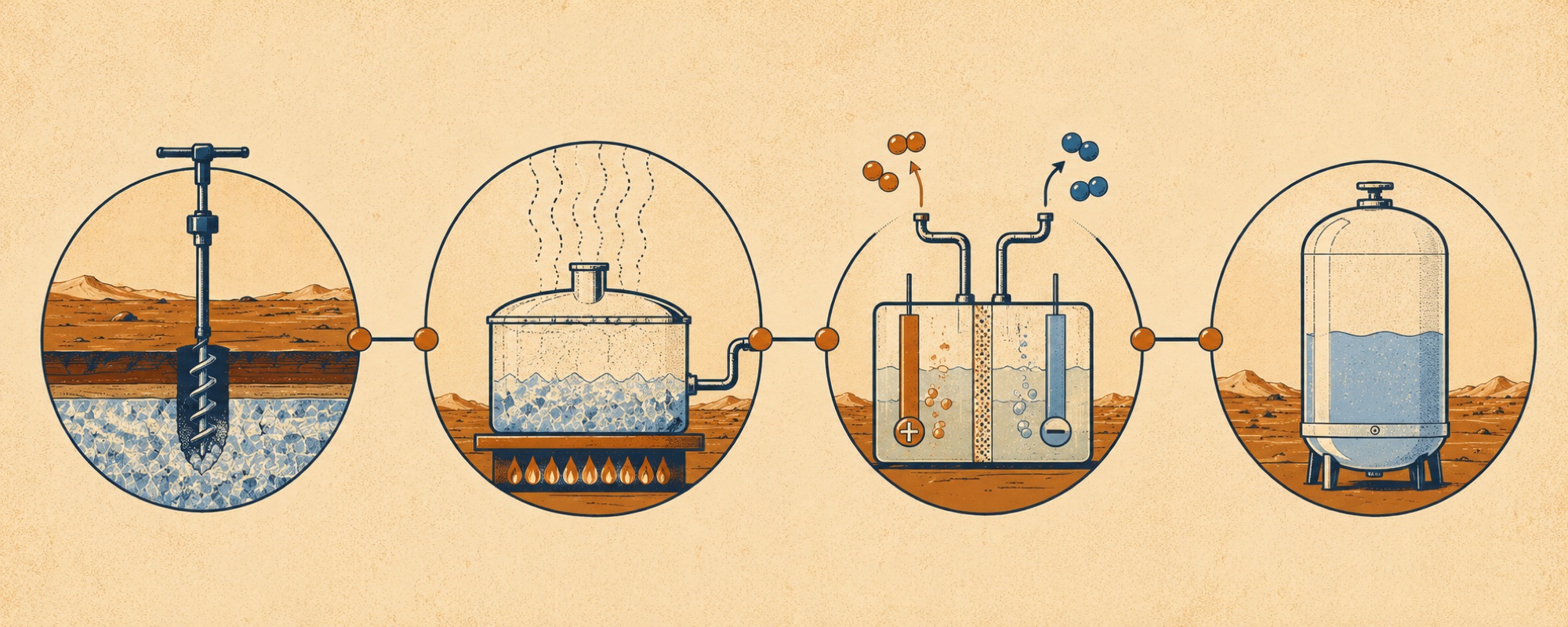
Dig the icy ground; apply heat; collect the vapour.
Distil out the perchlorate salts9. The clean water is already five-times enriched.
Run it through the electrolyser you brought for oxygen and propellant. Light hydrogen leaves first; deuterium stays behind. A catalytic exchange column — the CECE process10 — hands the deuterium back into the water, and cascaded stages climb past 99 percent heavy water.
Finish to deuterium gas by cryogenic distillation, or keep it as heavy water.
How — process stripdrop assets/stage0_process.jpgrecommended 2000×600 px (wide band)
Mine → melt → electrolyse (CECE) → store.
The energy all of this costs is well under a thousandth of the energy the fuel will return11. The thing to engineer is landed mass and reliability, not the power bill.
Application
Three Uses, In Order of Patience.
First: heavy water moderates a fission reactor so it can run on natural or lightly-enriched uranium — less cargo from Earth, because deuterium barely absorbs neutrons12. Second: a stockpile of stable deuterium waits, without spoiling, for the reactor that will burn it. Third, and longest: the deuterium itself is the fuel for deuterium-deuterium fusion — surface power for the dark and the dust, the day a machine exists to ignite it. (Tritium, if wanted, is bred from lithium, not from deuterium.14)
Why This Comes Before the Reactor
The Fuel Line Runs First.
Because the fuel is the easy half and the reactor is the hard half — and there is no reason to make the first wait on the second. No machine yet burns deuterium-deuterium at net gain, on Earth or on Mars; even deuterium-tritium net gain exists only as a laboratory flash13. But the mining, the purifying, the separating — every step has a working terrestrial twin.
So we build the supply, document the architecture, and let the reactor catch up to a fuel line that is already running. FUNNY ships the recipe. Someone else lights the stove.
Technical figures verified against the published literature (deuterium reservoir measurements, subsurface-ice mapping, heavy-water separation chemistry) and an internal physics review, June 2026. Reservoir D/H, fusion energy density, and separation chemistry are established science; the landing-site ground-ice enrichment is an assumption pending in-situ measurement.
Sources & Grounding
Check Our Work.
Every figure on the card is tagged by how it stands up. Click a number in the text to land here. Where a claim is an assumption rather than a measurement, it carries the orange tag — and so does the one number in this whole recipe that nobody has measured yet.
ReasonedHelium-3 is effectively absent on Mars — it has no lunar-type solar-wind-implanted regolith reservoir. Inference, not a single citation.
CalculatedD-D fusion energy density: 24 GWh/kg (basic two-branch) to ~96 GWh/kg (catalyzed); ~21 kt TNT/kg floor. Computed from standard D-D Q-values (4.03 & 3.27 MeV branches; ~43.24 MeV per 6 D catalyzed) at 1 t TNT = 4.184×10⁹ J. Arithmetic independently reviewed.Reaction Q-values →
AssumptionMid-latitude ground-ice D/H ≈ 5× VSMOW. No in-situ measurement exists; working value sits between measured atmospheric (~4.4–6×) and polar (≥8×) ice. This is the single biggest unknown in the plan.
MeasuredPrimordial/mantle Mars D/H ~1–2× VSMOW (near-terrestrial), from hydrous minerals in Martian meteorites — surface enrichment is an atmospheric-escape effect, not a deep reservoir.Jakosky & Hallis 2024, JGR Planets →
MeasuredArcadia Planitia hosts a shallow excess-ice layer up to ~75% ice by volume (radar-modelled).Bramson et al. 2015, GRL →
EstablishedSubsurface-ice mapping and the +1 km (above areoid) landing-altitude ceiling for entry, descent & landing.SWIM — Subsurface Water Ice Mapping →
MeasuredPerchlorate salts in Martian soil (0.4–0.6% by mass), first detected in situ by the Phoenix lander.Hecht et al. 2009, Science →
EstablishedCECE (Combined Electrolysis and Catalytic Exchange) — a real industrial heavy-water upgrading / hydrogen-isotope process: water electrolysis plus liquid-phase catalytic exchange on a wetproofed catalyst. Developed and pilot-proven by AECL.IAEA INIS (AECL Chalk River) →
CalculatedSeparation energy is well under 0.1% of the fuel’s own fusion yield (from claim 3). The specific per-gram separation figure is our own unbenchmarked estimate, so it is not quoted as fact here.
EstablishedHeavy water (D₂O) has very low thermal-neutron absorption, giving the neutron economy to run a reactor on natural or low-enriched uranium — CANDU design logic.CANDU reactor →
MeasuredNIF (Lawrence Livermore) achieved fusion ignition in Dec 2022 — 2.05 MJ in, 3.15 MJ out, target gain >1 — on deuterium-tritium fuel by inertial confinement, a single-shot lab demonstration. No device has achieved net energy gain on deuterium-deuterium fuel as of 2026.LLNL announcement →
EstablishedTritium is bred from lithium (n + ₆Li → T + ⁴He), not from deuterium — standard fusion fuel-cycle chemistry.Tritium breeding blanket →
Reservoir and ice values are peer-reviewed; fusion energetics and separation chemistry are established science; the landing-site ground-ice enrichment is an explicit assumption pending in-situ measurement. Internal physics review, June 2026.